|
What is the Classic Puzzle Cube?
...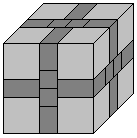 ... ... |
The "classic puzzle cube"
is a wooden cube made from eight small cubes and bands of darker wood between
them.
It is also called "the take apart cube" or "the classic
12 pieces puzzle".
It dates from the 19th century. |
Structure
...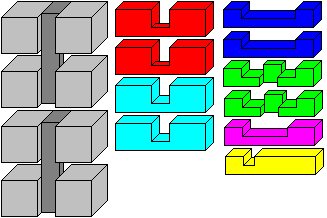 ... ... |
If you take the cube apart, you get two halves at first.
They are formed by two cubes, which are fixed at a bar. There are ten more
bars, which are stuck into each other and form the bands.
The problem is assembling a cube with all the 12 pieces. |
Solution in Three
Steps top
1st step: Build an H-shape as the first layer.
...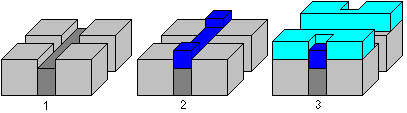 ... ... |
Set the dark-blue bar (2) into the groove of a half cube
(1).
Add the light blue bars (3). |
...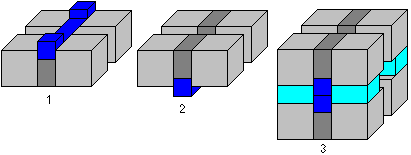 ... ... |
Set the other dark-blue bar (1) into the second half
cube. Turn over the half cube (2) and put it upon the first half cube (3). |
The four blue bars form an H inside the cube.
2nd step: Bracing the two half cubes
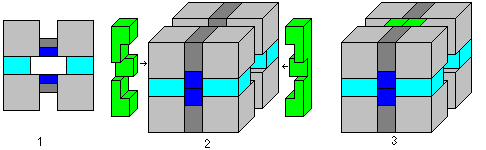
Look from the side into the cube. You recognize two connecting
dark grey/dark blue pieces in the center (1). Move in the two green bars
from the right and the left (2) and put it around the connecting pieces
(3).
Make sure in the following step that the green bars do
not separate, if the cube will be turned.
3rd step: Put in the two T-pieces
...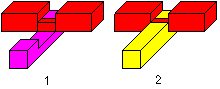 ... ... |
Make two T-pieces of the four remaining bars. They will
be put in from the top and from the bottom. |
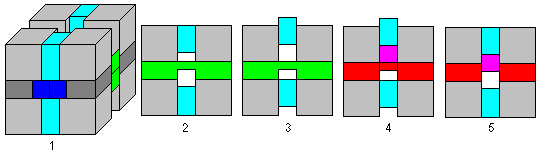 Turn over the cube 90 degrees, so that the right cube face
is underneath (result in 1). Look down into the cube. You recognize two
holes (2, white). Increase the upper hole for the red/pink T-piece.
Push away the dark blue bar together with the light blue ones above (3).
- Then put the T-piece into the cube from above, the red bar at first (4).
Return to the cube shape (5).
Turn over the cube 90 degrees, so that the right cube face
is underneath (result in 1). Look down into the cube. You recognize two
holes (2, white). Increase the upper hole for the red/pink T-piece.
Push away the dark blue bar together with the light blue ones above (3).
- Then put the T-piece into the cube from above, the red bar at first (4).
Return to the cube shape (5).
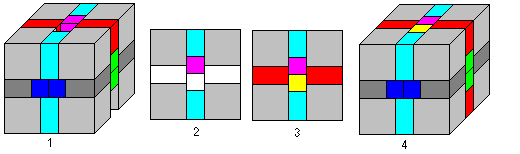 >Now the cube looks like the drawing (1).
>Turn over the cube, front side front (2).
>Put in the second red/yellow T-piece from above
(3).
The cube is finished (4)
; -).
Comments top
The puzzle cube is popular in Germany, also because it
is in the catalogue of the wide-spread VEDES toy shops.
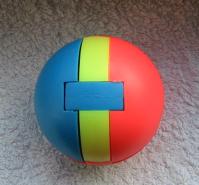
There is also a puzzle in a ball form or barrel form,
or with corners cut off.
I desribe the IQ Puzzle Ball on my German
web page Zerlegbare Kugeln.
Classic
Puzzle Cube on the Internet
top
Youtube
How
to solve the Cube, Wooden
puzzle cube
References top
(1) Rüdiger Thiele, Konrad Haase: Der verzauberte
Raum, Leipzig 1991
(2) Pieter van Delft /Jack Botermans: Denkspiele der
Welt, München 1980 (1998 neu) [ISBN 3-685-1998], Seite 66
(3) R.Thiele, K.Haase: Teufelsspiele, Leipzig, 1991 [ISBN
3-332-00116-7], Seite 40f.
Gail from Oregon, thank you for supporting me in
my translation.
Feedback: Email address on my main page
This
page is also available in German.
URL of
my Homepage:
https://www.mathematische-basteleien.de/
©
2001 Jürgen Köller
top |