What is Rubik's Cube? top
... ... ...
|
Rubik's Cube is a cube shaped puzzle.
At first glance it consists of 27 small cubes, which make
together a 3x3x3-cube. |
...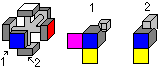 ... ... |
In reality there are 21 pieces: 1 main piece with three
axles, 8 corner pieces (corner cubes) with three colours and 12 edge pieces
(edge cubes) with two colours. |
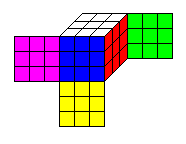 |
The colours of my cube are white/yellow, orange/red (here:
orange=pink) and green/blue. After several random turns the cube is coloured.
If the cube is solved, every lateral face has the same colour.
The main problem is solving the cube ;-). |
Solution of the SPIEGEL Magazine
slightly altered
Introductory top
Ernö Rubik, a Hungarian professor of physics and
design, invented the cube in 1974. About 1980 Rubik's cube spread out all
over the world like a virus. In the early 80's about 100 million cubes
were sold worldwide. People tried to solve it. But most of them kept to
one slice or to two slices.
In Germany the magazine DER SPIEGEL published the first
solution, which you could understand. This solution is still of topical
interest.
The copyright is at the SPIEGEL and the journalist Albrecht
Kunkel.
The following seven pictures show how the cube is solved.
(Picture 4 und picture 6 may be different.)
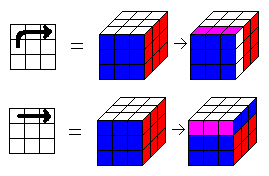 |
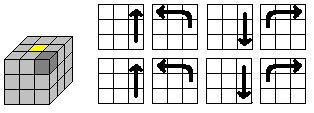
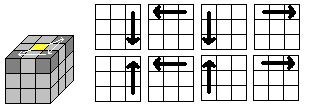
The turns of the slices are shown by a 3x3 square and
an arrow. The squares are always the front squares, the arrow describes
a quarter turn in direction of the arrowhead. The arrows are in the slice
you must turn.
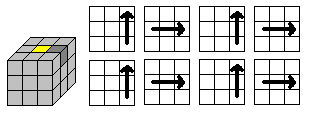
The illustration opposite shows the meaning of the squares
with arrows in two examples. |
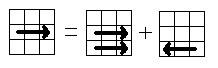
|
This is practical. . |
Remember one principle at the following
seven steps of this solution:
Never turn the cube itself but
only separate slices during the sequences of turning. That means the orientation
of the cube in space is always the same while turning.
Building the
First
Slice top
Solving the first and middle slice you have to hold the
cube so that the white centre of the face is at the top.
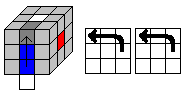
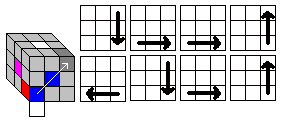
1st step: Solving the edge cubes.
You look for the edge cube blue/white and rotate it to
front/down/middle.
There are two possibilities 1a) or 1b).
1a) white underneath
1b) white in front
You repeat the moves with the orange, the green and the red
faces in the same way.
Result: On the top there is a white cross. The colours
of the edge cubes and the centre of the four faces have the same colour.
(Picture 1 of 7)
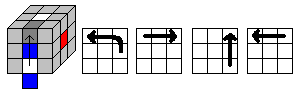
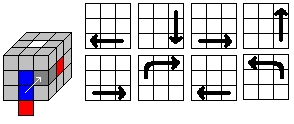
2nd step: Solving the corner cubes.
There are four corner cubes with the colour white. You
hold the cube so that white is at the top and blue in front.
E.g. you have to move the corner cube white/red/blue
to its correct position front/right/top.
First you move this cube to the place front/down/left.
There are three possibilities 2a), 2b) or 2c).
2a) white left
2b) white in front
2c) white underneath
In the same way you deal with the three remaining white corner
cubes.
Result: The top slice is completely white. The colours
of the edge cubes match the centre cubes.
Building the
Middle Slice top
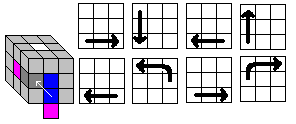
3rd step
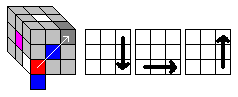
In the middle slice move only four edge cubes blue/orange,
blue/red, green/orange and green/red. You must do this by starting at the
bottom. You hold the cube so that white is at the top.
You have to turn the down slice so that one of the edge
cubes blue/orange or blue/red is at front/down/middle. There are two possibilities
3a) or 3b).
3a) to the right
3b) to the left
If the blue square shows underneath, you start with another
colour.
If all cubes are in the middle slice, move the cube down
to the middle by one of the sequences 3a) or 3b) first.
Result: The top slice and the middle slice are in the
right positions.
Building the
last Slice top
You turn the cube to solve the last slice (white underneath,
yellow at the top).
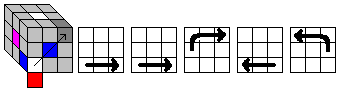
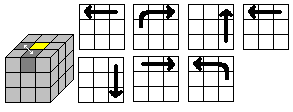
4th step: Switch the position of two cubes.
You turn one of the four edge cubes yellow/blue, yellow/orange,
yellow/green, yellow/red to the face with the correct colour (if yellow
is not at the top, don't worry!). If the remaining cubes are not
at the correct positions, you have to switch them over the left edge cube
at the top. Probably you will have to repeat this sequence. (Picture
4 of 7)
5th step: Flip the edge cubes
Though all edge cubes are in the correct position,
they might be wrong. Yellow is not at the top.
You have to flip them. You hold the cube so that the
edge cube is right/top/middle. Now there are eight moves.
If the cube is coloured after these 8 turns, go further.
Turn the next edge cube to be flipped to the same place right/top by turning
the whole slice (Don't turn the whole cube). Then there are the eight moves
again.
Result: There is a yellow cross. You turn the top slice
so that the edge cubes are at the correct places.
6th step: Switch the positions of three corner
cubes
First you move the four remaining corner cubes to the
proper positions. Their colours needn't be correct.-
If all four corner cubes are in the proper position,
then the following sequence is unnecessary.
If all the four corner cubes are at a wrong place after
aligning , then there are a further 22 moves:
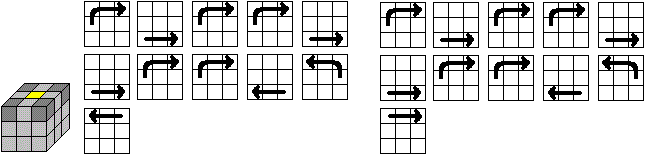 If all the four corner cubes are still in the wrong places,
you have to repeat the eight moves. The front face must stay in front.
If all the four corner cubes are still in the wrong places,
you have to repeat the eight moves. The front face must stay in front.
After these moves one corner cube is in a proper place.
Turn the cube so that this corner cube is back/left. Now you repeat the
eight moves.
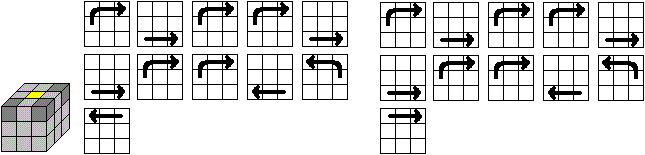 Result: The four corner cubes are in their correct places.
Comments to the 6th step
Short after publishing (4/1981) there appeared
a solution for the problem "switching the position of three corner cubes",
which I describe now. You only need 8 moves instead of 22.
 Ich tell this abbreviation conditionally.
7th step: Rotating the corner cubes.
The colours of a corner cube have to turn.
You hold the cube so that a corner cube is top/right/front.
Then there are eight moves.
If yellow is not at the top of this special corner cube,
you repeat these eight moves.
Then you turn the top slice (not the whole cube), so
that the next corner cube is top/right/front.
You repeat the 8 or 2x8 moves.
If all the four corner cubes are rotated, yellow must
be on the top. Now there is a last step. Turn the last slice. The six faces
have one colour. FINISHED!
Planned
Chaos top
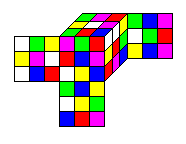
Is it possible to turn a cube so
that you have every colour on each face at least once? Yes it is.
(Start with blue at the front,
white at the top)
Taking
to Pieces top
You can also solve the cube by
taking it apart and putting it together.
There are some products with a
screw at the centre of a face. You can unscrew it. Then you can solve the
cube.
You can take apart most products
only with a little force. You turn the top slice about an angle of 45 degrees.
You lift the top slice with a screw-driver or a spoon-handle carefully.
In this position you can remove an edge cube and then the adjacent corner
cubes.
If you are very clever you solve the cube by removing
the adhesive films and sticking them again ;-).
Solving
with a Stop-Watch top
Those who can solve the cube see
the next challenge: Solving the cube as quickly as possible.
The times solving the cube are
different. It depends on the arrangement of the cubes at the beginning.
But there are average times.
The professional cube turners need
no more then 90 moves. They know a lot of sequences to enable react them
to special situations appropriately. They don't solve the cube step by
step. They see many cubes together.
Besides they use silicone oil.
Solving
the Cube with Little Numbers of Sequences top
Most of the people prefer a method
with a small number of sequences (not moves). If you solve the cube you
are not willing to look at a paper, you solve it by heart.
In this respect the SPIEGEL solution
is a good one.
If you have some practice you can
order the first slice easily. Step 2c) is not necessary, you can use 2a)
and 2b). You need only sequences of no more than eight moves.
Nevertheless you need 120 to 180
moves, because you have to repeat sequences again and again. If you have
bad luck you need 75 moves for the last step "Rotating the corner cube".
The cube can be solved with the Spiegel method in 2 to 3 minutes.
Some
Mathematics top
In the book of Trajber (3) there
is a mathematical theory of the cube.
You number the squares, which you can move, from 1 to
48 (48 = 6x9-6). A move or a sequence of moves brings you to a new arrangement
of the numbers 1 to 48. This is called a "permutation". All the permutations
form a "group".
So instead of looking into Rubik's Cube you can occupy
yourself with the group.
One interesting point in the theory of groups is transferred
to the cube:
If you repeat a move or a sequence of moves, you always
come back to the beginning.
If you would like to have some exercise with the sequences
of the SPIEGEL solution, you do it like this:
...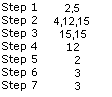 ... ... |
You take the solved cube and follow one sequence of moves
again and again. After n steps you come back to the
clear cube.
n is at the second column. |
Patterns top
A wide field of activities is finding new patterns.
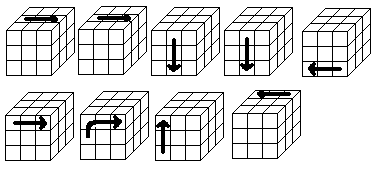
Here is an example, which you can develop to find more
patterns. (Each arrow means a quarter turn.)
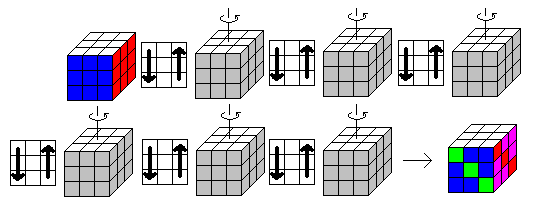
If you repeat the sequence, you return to the solved cube.
Variations:
...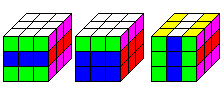 ... ... |
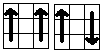
If you don't start with the solved cube, but with one
variant at the left, you get new patterns. |
|
If you turn the slices in another way, you get new patterns,
too. |
You get 12 patterns:
Devil's
Barrel top
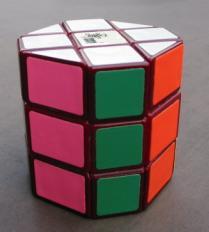
A variant of the cube is Devil's
Barrel. It is also called Octagon.
It is created from a cube by cutting off the four vertical
edges. In this way, ten surfaces are created that are coloured. It has
the mechanics of the Rubik's Cube and is solved according to the same rules.
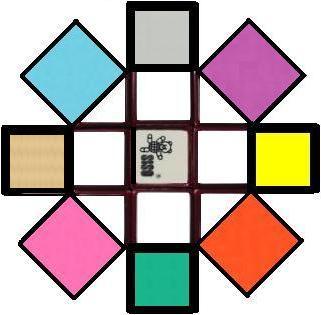
If you have mastered the cube, you will have no difficulties in arranging
it. However, you have to set a certain colour distribution for the first
level as you can see on the right. You only notice it whether it is correct
at the last level.
Rubik's
Cube on the Internet top
German
Lars Petrus
Rubiks
Zauberwürfel auf Zeit lösen
Oliver Reimann
Anleitung
für den Zauberwürfel
Rekord-Klub Saxonia
Rubik's
Cube
Ronald Bieber
Rubiks
Cube
Spiegel-Wissen
Schrei Hurra! Schmeiß 'ne Runde!
Die Spiegelausgabe 4/1981 vom
19.01.1981 ist jetzt (Feb2008) für den privaten Gebrauch freigegeben!
:-)
Wikipedia
Zauberwürfel
English
Georges HELM
Collection
of Rubik's cubes and related puzzles
Jaap Scherphuis
Rubik's
Cube 3x3x3, Barrel/Octagon
Lars Petrus
Solving Rubik's Cube
for speed
Nader (naderc)
CV
Rubik - Computer sees Rubik's cube and solves it (The Spiegel solution
as a video)
Rubik
on-line
Ernö Rubik's Official Homepage
Stefan Pochmann
Stefan
Pochmann's Cube Corner
Wikipedia
Rubik's
Cube
References (German) top
(1) DER SPIEGEL Nr.4/1981
(2) Josef Trajber: Der Würfel, Niedernhausen/Ts.
1981 (Falkenverlag 0565)
(3) Josef Trajber: Der Würfel für Fortgeschrittene,
Niedernhausen/Ts. 1981 (Falkenverlag 0590)
(4) Tom Werneck: Der Zauberwürfel, München
1982 (Heyne 4831)
(5) Tom Werneck: Der Zauberwürfel für Könner,
München 1982 (Heyne 4834)
(6) Kurt Endl: Rubik's Rätsel des Jahrhunderts,
Giessen 1981
(7) Alexander H.Frey, Jr and David Singmaster: Handbook
of Cubik Math, Hillside New Jersey1982 [ISBN 0-89490-060-9]
English / German
During the first ten years, from 1998 to 2010, I translated
my German-language web pages as best I could.
Back then, English was the language of the Internet even
more so than it is today.
If anything is unclear, please visit my German-language
website and use a translation program.
This
page is also available in German.
URL of
my Homepage:
https://www.mathematische-basteleien.de/
©
1999 Jürgen Köller
top |