|
What is the Origami Cube?
...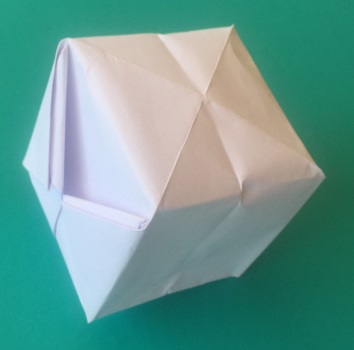 |
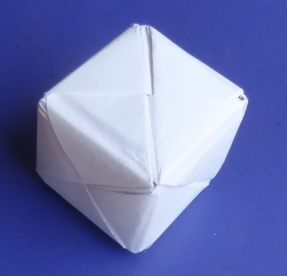
The origami cube is a cube you can fold from a square
sheet of paper.
Another name is water bomb. |
Folding the
Origami Cube
top
1
...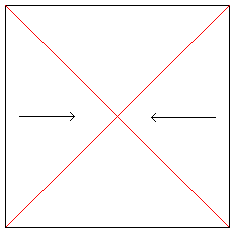 |
Fold a square sheet of paper at the diagonals and unfold
it.
Put the paper at both arrows together.
Lay the triangles at the top and at the bottom on top
of each other. |
02
...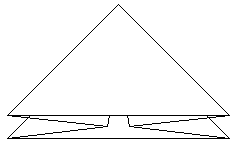 ............ ............ |
The result is a flier triangle, which is known from the
paper swallow...... |
03
...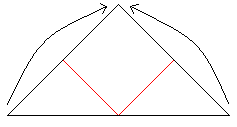 |
Fold upward on the red line on the right and on the left.................. |
04
...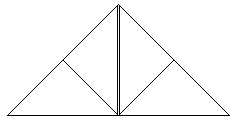 |
Then it must look like this............................................................ |
05
...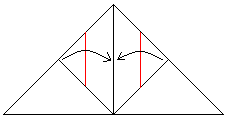 |
Fold on the red lines.................................................................. |
06
...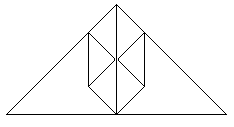 |
Then it must look like this.......................................................... |
07
...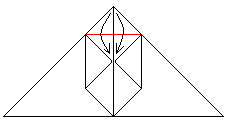 |
Fold the two little triangles on the red lines downward.................. |
08
...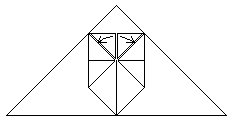 ............................ ............................ |
Put the last made triangles in the two pockets on the
right and on the left. This is a little bit fiddly. |
09
...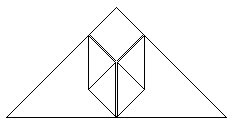 |
Then it must look like this......................................................... |
10
...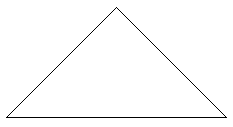 |
Turn the whole triangle and repeat the steps 3,4,5,6,7,8,9............. |
11
...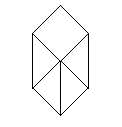 |
Then it must look like this............ |
12
...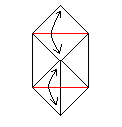 |
Fold and unfold on the red lines.
... |
13
...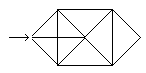 .............................................. .............................................. |
Take the folded cube in hand and blow into the hole at
the top. Unfold the cube by this... |
14
... |
finished........................... |
Some Mathematics top
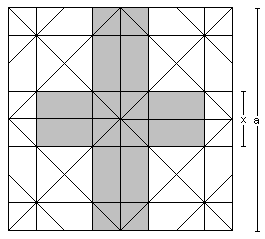 |
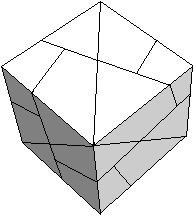
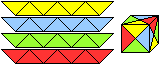
If you take the cube apart, you get a nice pattern, which
is made by the folds.
You find the formulas:
.........
|
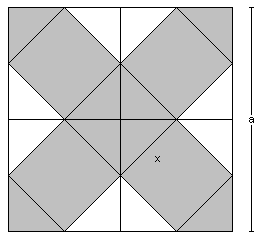 |
On the left you can see the largest net of a cube, which
fits a square.
You find the formulas
 . .
This cube is much bigger than the folded cube. |
If you like to use the whole square
for a cube, you have the formula
 .
This is the largest cube, theoretically. .
This is the largest cube, theoretically.
See more in book (5), page 63f. and page 71ff. "Der
eingewickelte Würfel".
More
origami cubes from one square top
Folding cubes is apparently a widespread art. There are
numerous instructions on YouTube on the Internet.
I looked around and found eleven more cubes - folded
from a square.

Let a be the side length
of the starting square and x the edge length of the cube.
01 Origami Cube (Shuzo Fujimoto)
Instructions can be found - if
necessary - under "01
Youtube" (URL below).
...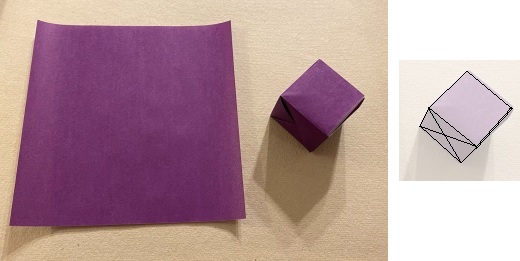 ... ... |
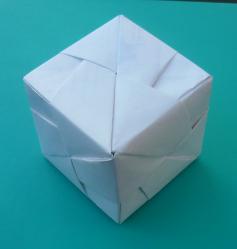
It is possible to fold a cube from a square sheet of
paper.
It has four smooth squares as sides.
Two opposite sides show the diagonals. |
...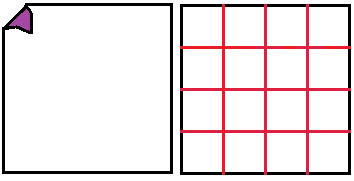 ... ... |
To build it, you need a 15cm x 15cm square of origami
paper, for example.
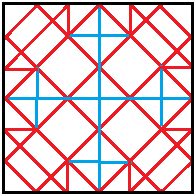
First create a 4x4 grid by folding it.
Make sure that the fold lines are only loosely defined. |
...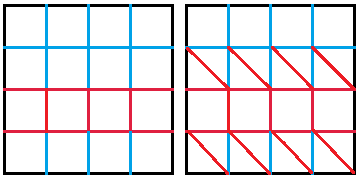 ... ... |
In a second step the fold lines are traced, e.g. with
a fingernail,
This is done according to the pattern shown in the drawing
opposite.
Valley folds are marked in red, mountain folds in blue.

|
...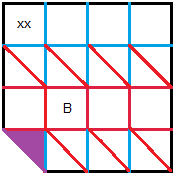 |
The bottom left tip is folded over, the colour of the
back becomes visible.
Two squares are labelled B and xx. |
...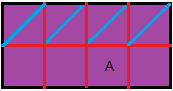 .... .... |
Then fold downwards at the centre line. A square is labelled
A.
Now it becomes three-dimensional. Push square A onto
square B so that the letters remain upright and lie on top of each other.
The mountain and valley folds must be observed. |
...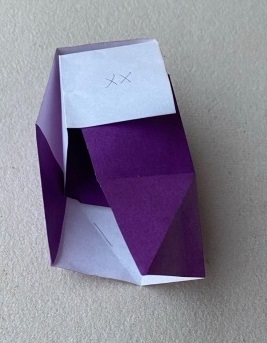 .. .. |
This is what the folding work looks like when you slide
A onto B.
This is what the folding work looks
like when you place A on B................................................................... |
.....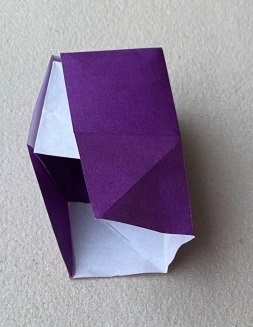 . . |
Move the square xx under the violet square underneath.
You can form one side of the cube with visible diagonals. |
...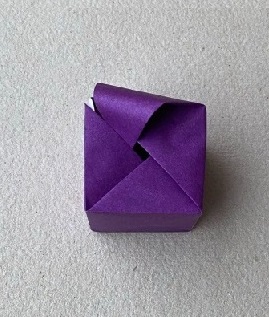 ... ... |
Close the opposite side by following the fold lines.
a = 4x or x = 0.25a |
02
Origami Seamless Cube
Instructions can be found under
"02 Youtube"
(URL below).
The Seamless Cube has six smooth
squares.
...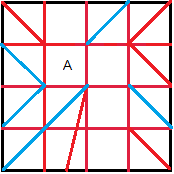 ... ... |
If you go back from the finished cube to the square,
you get the picture on the left.
|
...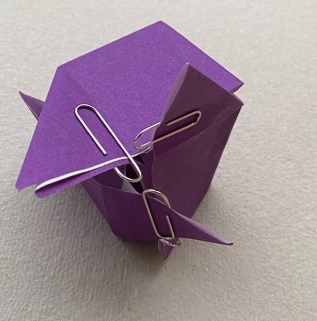 ... ... |
One step that is not easy is to shape the pre-folded
square into a cube.
The square at the top with the letter A is the base.
Once the cube has been successfully formed, three points
protrude from one corner.
They are placed in the pockets provided.
a = 4x or x = 0.25a |
03
Cube with lid
Instructions can be found under
"03 Youtube"
(URL below)
..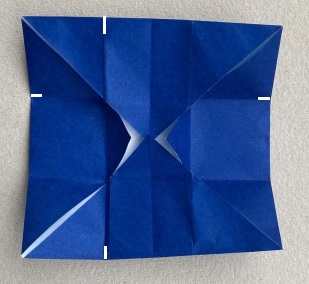 . . |
Once you have reached this point, you have to cut the
side length into thirds.
Experienced folders can do this by folding.
It is easier to divide into thirds if you use a ruler
to draw at least one mark. |
...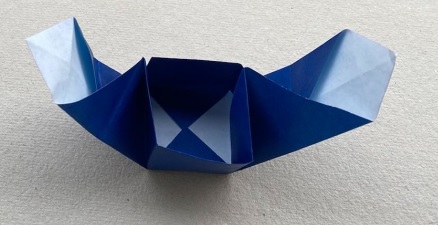 |
In this phase, the folding work
has two potential lids.
You can push one lid into the cube
and get a cube with a lid. |
...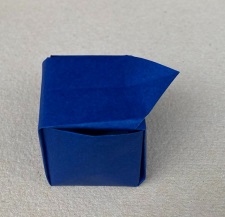 |
If you want to create a smooth
cube, you have to push the potential lids into each other.
You can make the points right corner
disappear. |
...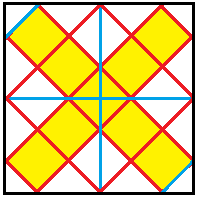 |
If you go back from the finished cube to the square,
you get the picture on the left.
a = 3sqrt(2)x or approximately x = 0.24a |
04
ORIGAMI SEAMLESS CUBE (Jo Nakashima)
Instructions - if necessary - can
be found under "04
Youtube" (URL below).
...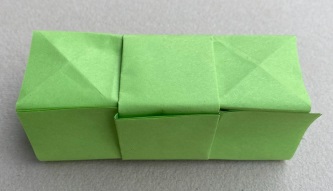 |
The way to make this smooth cube is easy to understand.
You fold a tube from three cubes, leaving the ends open.
The openings are closed with the open cubes. |
...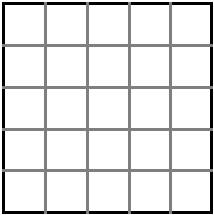 |
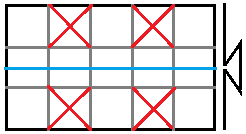
You need a 5x5 grid. Either draw it or fold it shown
in the video. |
...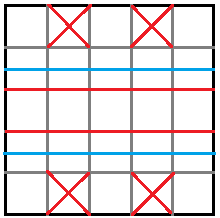 |
In a first pass, four squares are given a cross as valley
folds.
This is followed horizontally by two valley folds and
two mountain folds. |
... |
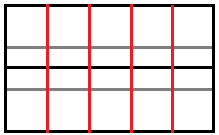
This makes it possible to push the square together so
that the mountain folds abut each other. |
... |
Four valley folds make it possible to form a "tube". |
| ... |
Push the centre bead into each other. |
...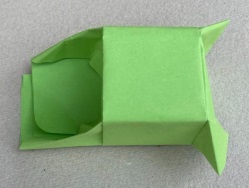 |
Then close the openings as shown on the left and form
points as shown in the photo on the right. |
...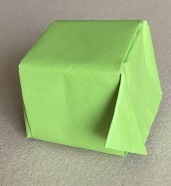 |
The four points are pushed into the pockets on the outside.
This is tedious. It works better if you sharpen the folds
of the points again.
a = 5x or x = 0.2a
|
05
Origami Gift Box
Instructions can be found under
"05 Youtube"
(URL below).
....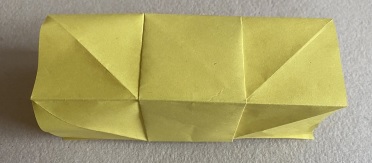 .. .. |
This cube is similar to cube 04,
which also uses a tube made of three cubes.
The difference is that the openings are closed more simply,
as in the final phase of cube
the end phase of cube 01.
The result is not a smooth cube, but diagonals can be
seen opposite each other. |
........
01
|
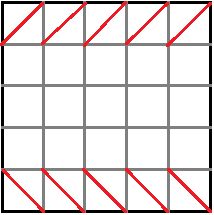 .... ....
05
|
Here you can see the difference between Cube 01 and Cube05.
a = 4x or x = 0.25a |
...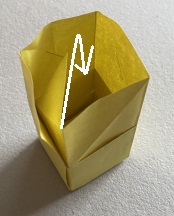 ... ... |
You need to know this:
Where two squares lie on top of each other, you only have
to press the inner square down into the cube when closing. |
06
Origami Gift Box / Ring Box Puzzle
Instructions can be found under
"06 Youtube"
(URL below).
...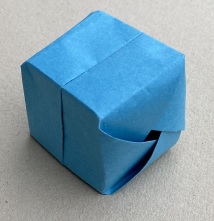 ... ... |
The almost identical cube as 06
is presented, but the finished cube has a groove in the centre because
the tube is folded the other way round.
a = 4x or x = 0.25a |
07
Cube from the net
Instructions can be found under
"07 Youtube"
(URL below).
...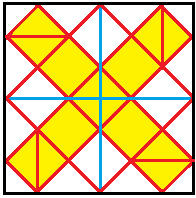 ... ... |
This is an obvious method of folding a cube from a square.
You can see the net of the cube, where four squares are
used for the lid.
The white squares disappear inside.
a = 3sqrt(2)x or approximately x = 0.24a |
...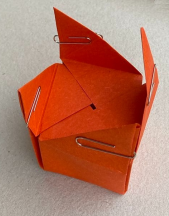 |
It is difficult to form the four points, but it can be
done.
The points are placed on top of each other and the last
one is tucked away. |
08
Origami Gift Box with one piece of paper
Instructions can be found under
"08 Youtube"
(URL below).
...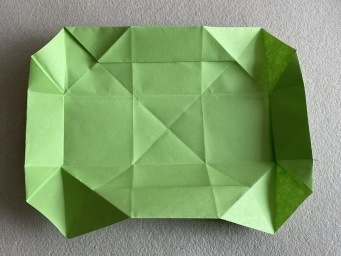 |
This is the moment when folding is no longer necessary.
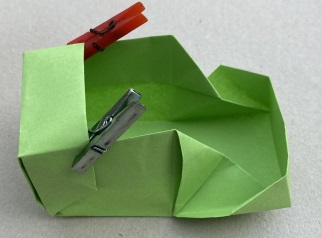
It then becomes three-dimensional |
... ... ... |
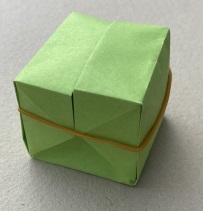 ... ... |
The cube has two halves.
When not in use, it is open a little bit. |
 |
If you go back from the finished cube to the square,
you get the picture on the left.
a = 3sqrt(2)x or approximately x = 0.24a |
09
Origami Box with Lid
Instructions can be found under
"09 Youtube"
(URL below).
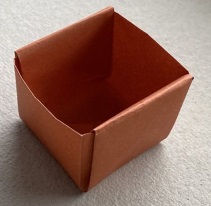
It is not possible to close
the cube without help. The open cube is stable.
...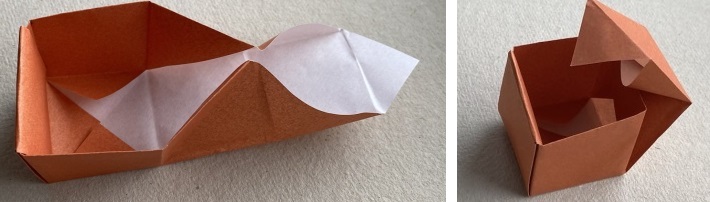 ... ...
...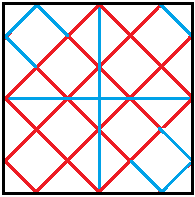 |
If you go back from the finished cube to the square,
you get the picture on the left.
a = 3sqrt(2)x or approximately x = 0.24a |
10
Fancy Origami Cube
...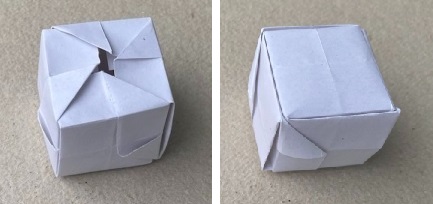 |
Instructions can be found under
"10 Youtube"
(URL below). |
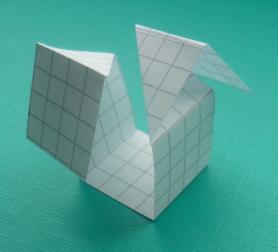
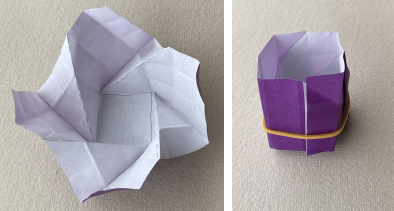
The special thing is that
you can form an open-top cube with just a few folds.
...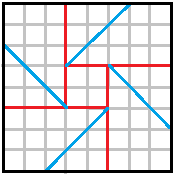
.....a = 4x or x = 0.25a |
 |
11 Origami
Cubic Dice
Instructions can be found under
"11 Youtube"
(URL below).
...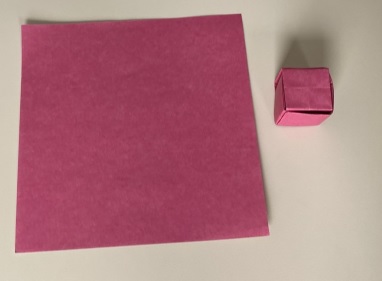 |
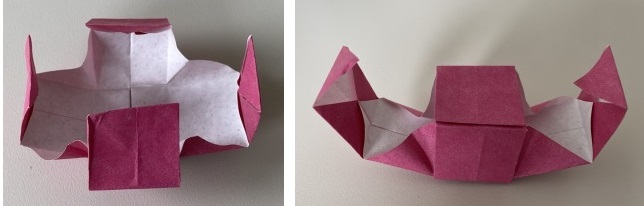 |
...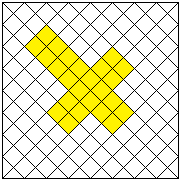 |
Compared with the cubes presented so far, this is the
smallest.
a = 4*sqrt(2) x or approximately x=0.17a. |
Origami
Cube from several Squares top
12 Cube
made from two squares
Instructions can be found under
"12 Youtube"
(URL below).
...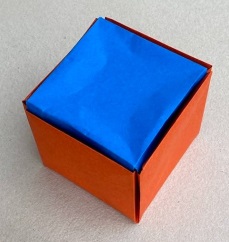 ... ... |
It is obvious to create a cube with two cubes open at
the top.
One cube is inserted upside down into the other.
To do this, you have to make sure that the inner cube
is slightly smaller. |
...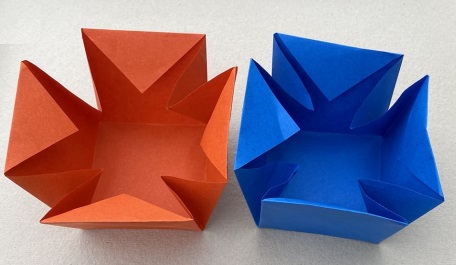 ... ... |
In this video, the problem is solved more elegantly.
You fold two identical cubes that are open at the top.
The cubes are then pushed into each other over the wedges
between the squares into each other.
The video shows how this is done. It can be done with
patience. |
13
DIY : Origami 3D Cube
... ... ... |
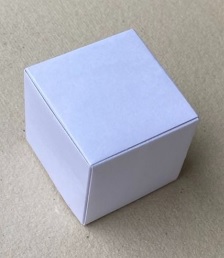 ... ... |
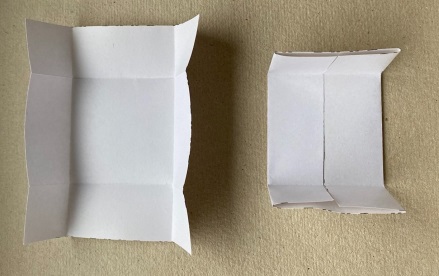
The cube is made up of six U-shaped modules.
How the modules are put together is shown in the video
"13 Youtube" (URL below). |
14
Cube of six Sonobe modules
... ... ... |
 ... ... |
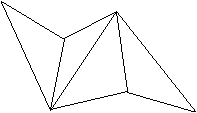
How six modules are folded and put together is shown
on my web page
Sonobe Star. |
15
Variant of the Sonobe cube
How six modules are folded and put together is shown on my
German web page Körper flechten.
Cubes from Strips top
16 Cube made of three strips
...
More details on my German website
Körper
flechten
17
Open cube made of six strips
...
More details on my website Körper
flechten
18
Cube made of four strips
19
Cube made of one strip
Origami-Cube
on the Internet top
Englisch
Dr Stephen O'Hanlon (Ring of Origami Art)
Water
Bomb ( .pdf file)
Erik Demaine (Video Youtube)
New
Ways to Fold a Cube from Paper
Gerwin Sturm (Origami for everyone)
Waterbomb
01 Youtube "Origami with
Thao Bui"
Origami
Cube - "Magic" Cube (Shuzo Fujimoto)
02 Youtube "JeremyShaferOrigami"
Origami
Seamless Cube
03
Youtube "ORIGAMITO"
Wie
man eine Papierschachtel mit Deckel macht
04 Youtube "ORIGAMI
SEAMLESS CUBE (Jo Nakashima)"
ORIGAMI
SEAMLESS CUBE
05 Youtube
"Origami
Gift Box - (@easyorigamiAndCrafts)"
Origami
Gift Box
06
Origami Gift Box / Ring Box Puzzle - (@Easy Origami)
Origami
Gift Box / Ring Box Puzzle
07 Youtube "Closed Origami
Cube Box Instructions - DIY - Paper Kawaii"
Closed
Origami Cube Box
08 Youtube
"Origami Gift Box with one piece of paper - Mica's Paper Craft C"
Origami
Gift Box
09 Youtube
"Origami Box with Lid How to make Origami box" - ArtsfronmHeart
Origami
Box with Lid
10 Youtube "Fancy
Origami Cube Tutorial (Hyo Ahn)"
Fancy
Origami Cube
11 Origami
Cubic Dice
Origami
Cubic Dice
12 Youtube
"Kokko
Garden - Würfel aus zwei Quadrate"
Würfel
aus zwei Quadraten
13 Youtube "Ventuno
Art How to Fold an DIY : Origami 3D Cube"
3D
Cube
German
Michael Schmitz (Mathegami)
Der
Kolumbus-Würfel
Wikipedia
Wasserbombe
(Spielzeug)
zzzebra
Wasserbombe
References top
(1) Joachim Schönherr, Wir falten und falzen, Leipzig
1990
(2) Therese Mielhaht: Origami Spaß mit Papierfalten,
Köln 1990
(3) Kunihiko Kasahara: Origami - figürlich und geometrisch,
München 2000
(4) Kunihiko Kasahara: Origami - ohne Grenzen, München
2001
(5) Martin Gardner: Mathematische Hexereien, Berlin/Frankfurt
am Main/Wien 1988 [ISBN 3550065787]
English / German
During the first ten years, from 1998 to 2010, I translated
my German-language web pages as best I could.
Back then, English was the language of the Internet even
more so than it is today.
If anything is unclear, please visit my German-language
website and use a translation program.
This
page is also available in German.
URL of
my Homepage:
https://www.mathematische-basteleien.de/
©
1999, enlarged 2024, Jürgen Köller
top |
 ...
...