|
Zeppelin
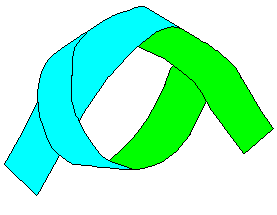
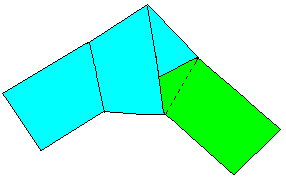
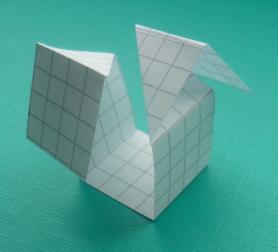
Cut two notches into a strip of paper (e.g. 1cm x 10cm)
as shown in the drawing. Bend the strip in the middle and fasten
the two ends with the help of the two
notches.
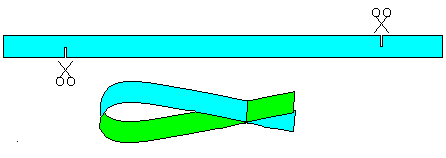 The resulting shape reminds you of a Zeppelin airship. It
is interesting to discover that if you drop the Zeppelin it rotates around
a horizontal axis if you offer a little help as you release it.
The resulting shape reminds you of a Zeppelin airship. It
is interesting to discover that if you drop the Zeppelin it rotates around
a horizontal axis if you offer a little help as you release it.
The Zeppelin demonstrates stability in its descent because
its moment of inertia is minimal. The shape causes a torque which maintains
the rotation.
It is said that playing with this was very popular in
the 1930's when the public's interest in airships was at its height.
Knot top
It is a surprise to discover that a pentagon appears
when you tie a knot in a strip of paper.
...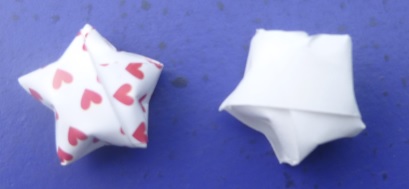 ... ... |
The knot becomes a threedimensional star, when you loosely
wrap the strip around the pentagon several times, put the ends inside,
and make indentations with your fingernail.
You can find the "Lucky Star"on the internet (URLs below). |
Dish of a strip top
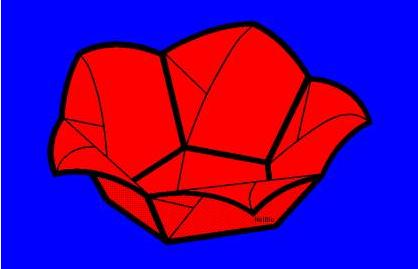
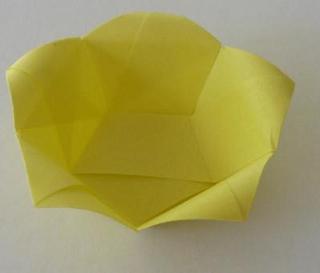
Helmut Bichler sent me a dish and its drawing, which
is formed of six pentagons. It is special that it is folded of one telex
strip and that the beginning and the end meet at the same place.
...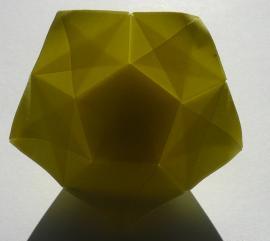 ... ... |
You can recognize in the backlighting technique, that
each pentagon has a pentagram inside.
You can interpret the dish as part of the dodecahedron. |
Producing a Sound top
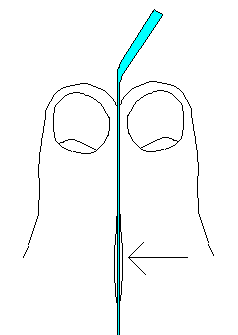 |
If you place a strip of paper (e.g. 1cm x 10cm) between
the two balls of the thumbs and blow strongly into the little gap beneath,
you will produce a loud, rude sound.
You can produce a similar sound if you use a wide blade
of grass. |
Spiral top
...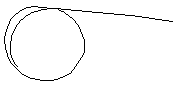 ... ... |
A strip of paper becomes a spiral, if you pull the strip
between the thumb and the edge of a knife, pressing hard. The spiral becomes
a curl where gravity is present. |
You use this effect to decorate the ends of synthetic materials,
such as the narrow colourful strips or ribbons used in gift-wrapping.
I suppose that you have to explain this effect in the
same way as a bimetallic bar. You create a bimetallic bar by glueing together
two strips, each made of a different metal. Once this bimetallic bar is
heated, one metal strip expands more than the other causing the bar to
bend.
The reason that the strip of paper bends is not the difference
in temperature between the top and bottom side. The knife changes the structure
of the surface of the paper. This side becomes 'shorter'. (Origin: Sendung
mit der Maus und TH Aachen)
Incidentally, a strip of paper will bend slightly if you
hold it in the heat of a candle flame.
Moebius' Strip top

If you glue both ends of a strip of paper you produce
a ring, as shown on the left. If, however, you turn one end of another
strip and glue the ends, the result is the so-called 'Moebius strip' on
the right.
If you cut the ring on the left lengthways in the middle,
then you have two rings.
Variations:
If you cut the ring in the same way,
expect a surprising result!
Bill from Michigan gave my a hint:
"Did you ever cut a Moebius strip along the 1/3 line,
instead of down the middle? Try it!"
...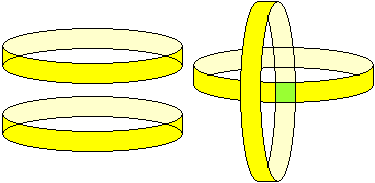 ... ... |
>Glue two rings on each other, turning one ring through
90°. The glueing area is green.
>Cut the first ring, then the second one lengthways in
the middle one after the other.
There are surprising results. |
Andreas Reichelt from Neckargemünd told me this playing
with strips.
Strip to Cube
top
Fold a strip 1x7 into a cube.
By Martin Gardner
More Paper Foldings
top
You also need strips for paper foldings on my following
web pages.
Froebel
Star
Flexagon

Flexatube
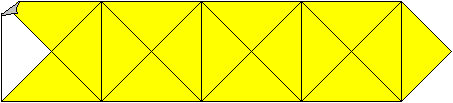
Kaleidocycles
Körper
flechten (German only)

A
Strip of Paper Only on the Internet top
German
Heinz Strobl
Knotologie
Kapege/Spielkeks
Möbiusband
selbstgebastelt
Kikisweb
Durch
eine Postkarte steigen
Labbé
Scherenschnitt
Papierketten, Drehschlange
Youtube
Hexentreppe
falten, Girlande
"Hexentreppe" falten
English
Art contest at the Hirshorn Modern Art Gallery in DC
One
Sheet of Paper
Heinz Strobl
My Strip
Tease Gallery
June Gilbank
Lucky
Wishing Stars Tutorial
origami-resource-center.com
Origami
Lucky Star
Paula Beardell Krieg
How
to Make a Paper Spring
Youtube
How
to make a paper snake, WALKING
THROUGH A POSTCARD
Feedback: Email address on my main page
This
page is also available in German.
URL of
my Homepage:
https://www.mathematische-basteleien.de/
©
1999 Jürgen Köller
top |